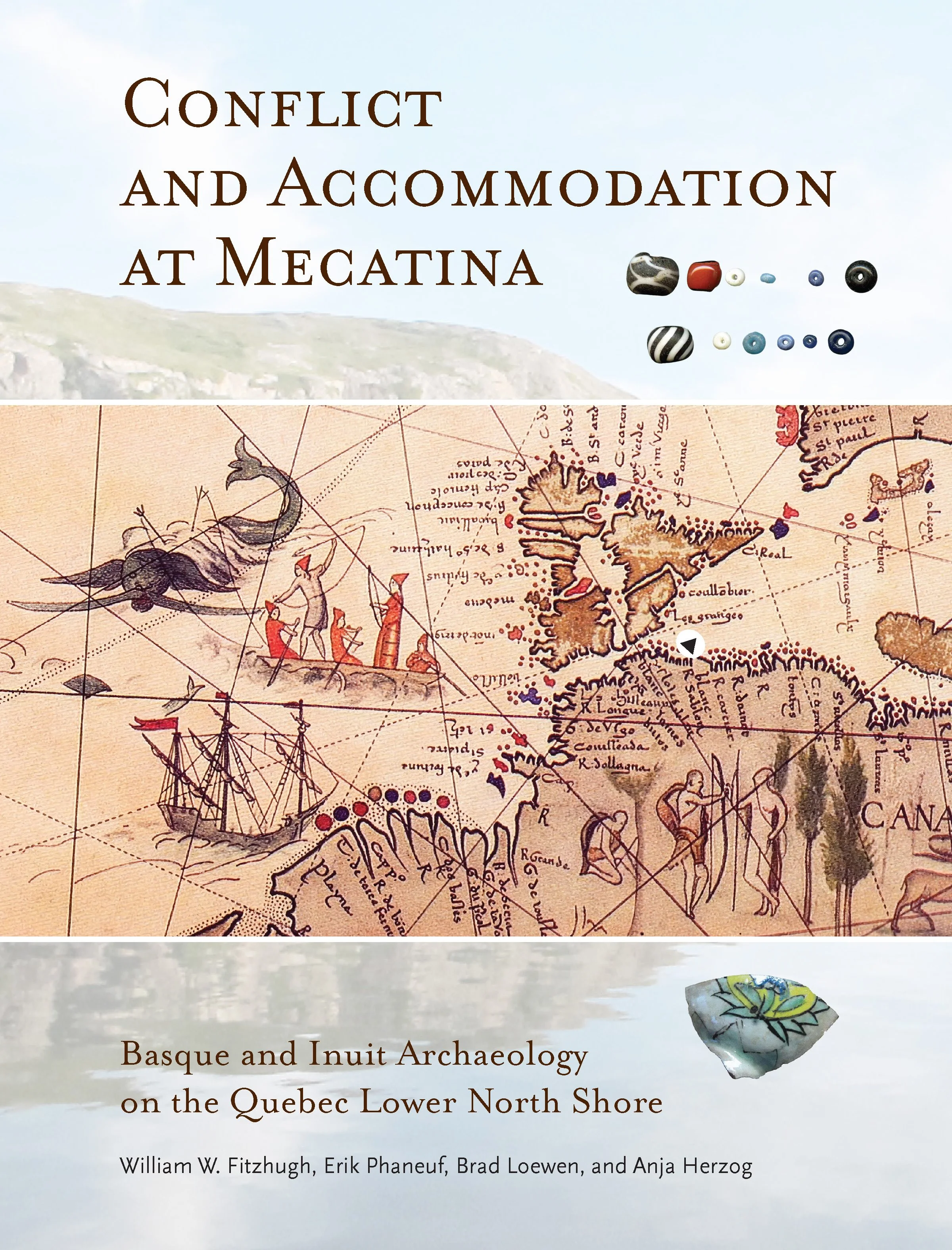
conflict and accommodation at mecatina
Basque and Inuit Archaeology on the Quebec Lower North Shore
William Fitzhugh, Erik Phaneuf, Brad Loewen & Anja Herzog
438 Pages, 8 × 10.5”
Paper, $30 ISBN 979-8-9884732-9-9
In the late 16th century two groups from opposite ends of the world appeared in Grande Baya – the northeastern Gulf of St. Lawrence—where they interacted for the next hundred and fifty years. Labrador Inuit, migrating from Alaska as Thule culture whale hunters, reached their southernmost settlement limit in the Northeast Gulf shortly after the arrival there of Basque whalers from northern Spain. During this time, both groups competed and cooperated as whalers and fishermen, leaving a remarkable land and underwater record of their activities at Petit Mécatina, 150 miles west of the Strait of Belle Isle.
The Mécatina site was first visited in the 1590s by Basque whalers who left extensive archaeological deposits underwater and on land. A second occupation in the 17th century contains both Inuit and Basque structures that shared material culture: a Basque cook-house operated by Inuit, a blacksmith shop, and two Inuit dwellings, one attacked and destroyed by fire, and a second—full of Basque artifacts—that was abandoned in haste.
The twelve years of land and underwater excavation, thousands of archaeological and zooarchaeological finds, and data from archival records in Spain and Quebec reveals a complex story of conflict and accommodation by two cultures—European and Inuit—that found themselves together, far from their homelands, in a ‘wild west’ venture at the edge of the Arctic. Facilitated by the Little Ice Age cooling that brought Arctic ice, whales, and caribou deep into the Subarctic, the Mécatina story reveals the opportunities and dangers involved when cultures meet in an unfamiliar setting. Not knowing whether to trust or fear their neighbors, each side needed the other to accomplish their needs and goals. In the end, the march of history and a cataclysmic earthquake ended the Mécatina occupation. By the middle of the 18th century, as colonial power became established along the Quebec Lower North Shore, both Basque and Inuit withdrew to ancestral homelands and were replaced by other European and Indigenous groups. The story of Mécatina is not unique in American Encounters, but it is a rare instance that has been documented at a single site through combined terrestrial and marine archaeological research.